
Antoni Gaudi and The Transcendence of Via Pulchritudinis: the Philosophy of Neuroaesthetics in Biomorphic Architecture

Colorful Inside of the Sagrada Familia by Tim Kicker - Creative Commons License
For centuries, the relationship between architecture and beauty has engaged our thoughts. We have tried to label beauty inside a box of definitions. Philosophers discuss it, theologians analyze it, and designers include it in their discourses, though they often dismiss it as a fleeting or ephemeral whim, an extravagance that has everything to do with personal taste. Beauty, in modern times, frequently prioritizes performance, economics, technology, and production of interesting images, despite being understood as a cultural or spiritual act for much of our history. Many individuals have always thought that beauty is something far more enduring, that it is not merely decoration, but a quiet and profound declaration of perceptible truths. I count myself among them.
There is an ancient theological concept called the Via Pulchritudinis, the Way of Beauty in Latin, a profoundly philosophical and aesthetic idea that proposes a path to knowledge, the revelation of deeper truths and realities. It is the radical notion that encountering something profoundly beautiful is not merely a fleeting aesthetic emotion, but a path to transcendence. A physical gateway to something greater than ourselves. Instead of attempting to understand the divine, the universe, or the meaning of existence through purely logical or moral thought, it uses beauty as the primary means for the awakening the human spirit. The Via Pulchritudinis argues that in a world that is often fragmented, noisy, or purely utilitarian, the intentional creation or preservation of beauty is a vital healing act.
"Love of beauty is a path to the higher world... using it only as stepping stones."
Plato
In classical philosophy, starting from Plato, who established the initial concepts of the Way of Beauty, to medieval thinkers like Saint Augustine, who associated beauty with order, proportion, and harmony, and Saint Thomas Aquinas, all the way to modern theologians like Hans Urs von Balthasar, who stated that aesthetics cannot be separated from truth and goodness. All of them stated that beauty was not merely an aesthetic preference, but a transcendental force that rescued the soul from the mundane, elevating it toward the heavens and the most essential truths. Therefore, architecture plays an important role in communicating meaning and those theological truths through form.
For these philosophers, reality was understood through three main attributes, known as the transcendentals. Veritas (Truth), which appeals to human intellect and reason, satisfying our desire to know. Bonitas (Goodness), which appeals to our will and morality, guiding our actions and personal ethics. And Pulchritudo (Beauty), which appeals to our senses, emotions, and intuition simultaneously.
"Beauty requires three conditions: first, integrity or perfection... second, proper proportion or harmony... and lastly, clarity or splendor."
Saint Thomas Aquinas
Several architects throughout history could be considered as representatives of this aesthetic-theological philosophy, ranging from the medieval to the contemporary avant-garde. Swiss architect Peter Zumthor, with his mastery of materials and presence, is perhaps the definitive practitioner of the Via Pulchritudinis. Although he speaks of it in terms of atmosphere and phenomenology rather than truth and beauty, his buildings prioritize how materials and light make their users feel before reason is able to provide an understanding of what they are experiencing. Louis Kahn, with his monumental honesty in his use of materials, was an architect obsessed with what he called the "spirit" of materials and the cosmic quality of natural light. He famously spoke of asking the bricks what they wanted to be, seeking authentic beauty based on structural truth. Or Tadao Ando, the minimalist of light and voids, who uses exposed reinforced concrete with silky textures to create spaces of profound silence. Although his designs are minimalist, and he strips his spaces of all ornamentation, he allows the purest elements of nature—light, shadow, and wind—to become the ornamentation.
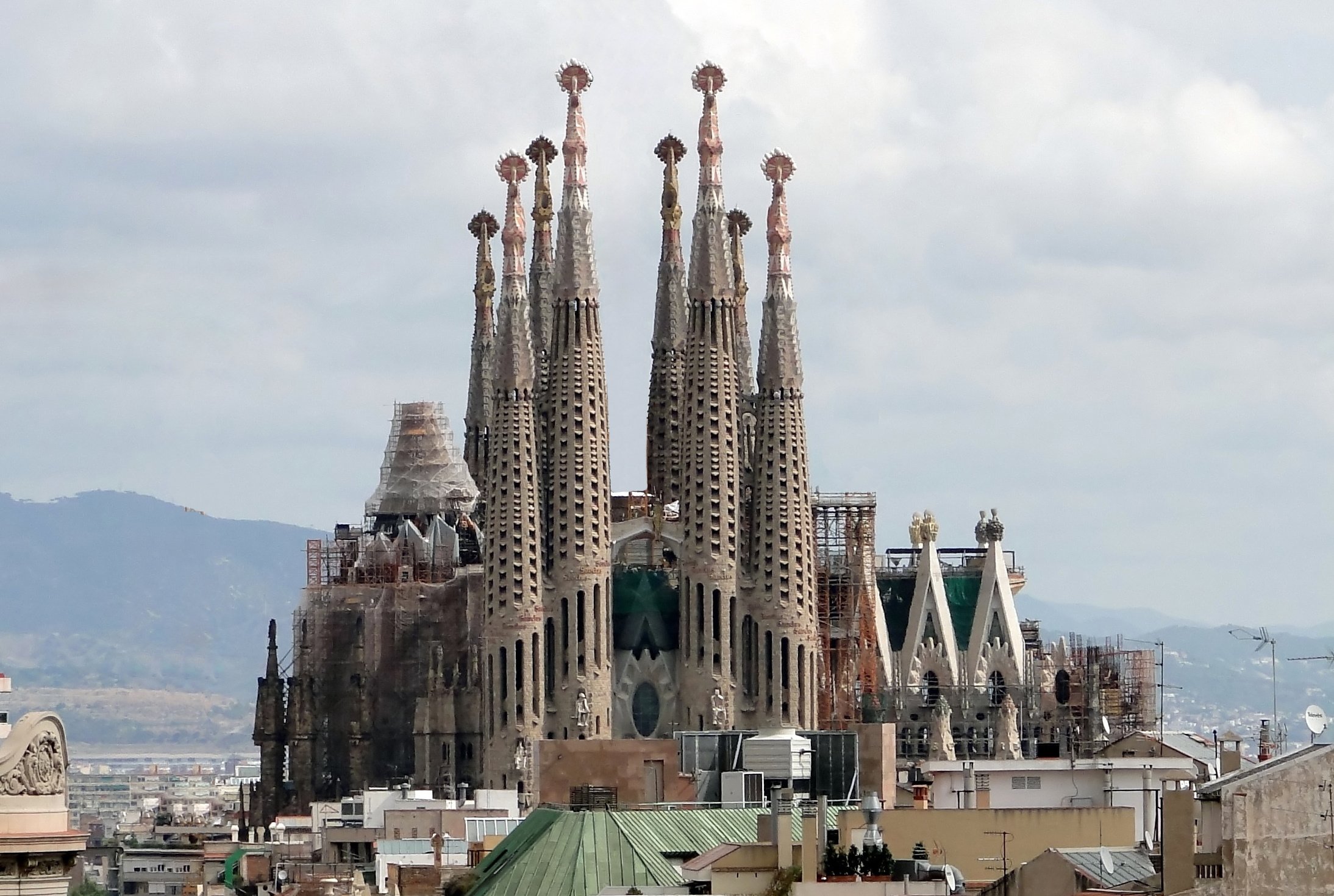
Sagrada Familia by Bernard Gagnon - Creative Commons License
But in my opinion, the architect who best constructed that portal to transcendence did so with biomorphic stonework bathed in natural light. Antoni Gaudí understood that a building not only had the obligation to house our lives, but should also awaken us from the lethargy of modern life. The architectural work of Gaudí cannot be understood without analyzing its profound integration with the Via Pulchritudinis. For him, a devout Catholic, beauty was not merely artistic embellishment, but an objective, an end, a transcendental reality that linked human perception with divine truth. When you see his later work, you are not just seeing architecture, you are seeing the convergence of geometry, faith, human craftsmanship, and nature, all speaking simultaneously in a voice frozen in stone. These buildings not only protect us from the elements, they communicate, they speak to us, they evoke a sense of wonder that approaches the spiritual, reaching a crescendo in his unfinished masterpiece of the Expiatory Temple of the Sagrada Familia.
During my years as a student, I used to think that architecture was an imposition on the environment, the way "starchitects” do, that man was forcing his will upon the ground. But Gaudí saw it the other way around. For him, the most important book wasn't in a university library; it was the book of nature, written by a divine intelligence. Years later, I understood that the true beauty of architecture can only be achieved through the physical and emotional interaction between the human body, its senses, and the built environment.
“...Gaudí saw it the other way around. For him, the most important book wasn't in a university library; it was the book of nature, written by a divine intelligence.”
It is well known that Gaudí operated under the conviction that the natural world was an uncorrupted form of divine revelation. Literally a book of nature written by its creator. He argued that human architects should not attempt to invent new geometric paradigms, but rather learn to read, decipher, and implement the laws already manifested in this natural creation. He observed that nature does not use straight lines or perfect right angles, demonstrating that Euclidean geometry did not exist natively in the universe. Nature, instead, presents continuous, undulating, and structurally optimized curved surfaces. By aligning his design language with these organic geometries, Gaudí sought to make human construction resemble divine order, creating spaces where the physical environment itself functioned as a constant theological discourse, whispered directly to our senses in a way that is imperceptible to our rational mind.
When you look closely at his structures, you realize that he wasn't simply copying the shape of a leaf or the curve of a seashell for the sake of a pretty facade. It wasn't superficial biomorphism; he was studying the engineering of the natural world. He observed trees, beehives, geological fractures, and saw efficient and beautiful structural solutions. The architectural work of the master Gaudí cannot be understood without analyzing its profound integration with the Via Pulchritudinis.
Under the framework of the classical metaphysics of Saint Thomas Aquinas, fundamentally unified through the three transcendental attributes mentioned earlier, Gaudí envisioned the role of the architect not as a master builder, a technician, or an autonomous stylist, instead he saw it as a humble intermediary whose task was to simultaneously materialize these three attributes in the built space. He believed that structural truth or honesty was inseparable from human moral goodness, and that both should be made evident through the creation of beauty. In Gaudí's personal worldview, if an architect designed something using the structural efficiency of nature, they would be performing an act of co-creation, thus achieving a manifestation of truth with the resulting aesthetic splendor. This approach positions aesthetic beauty as an instrument designed to attract human attention, dissolve existential anxieties, and elevate the human intellect toward a transcendent contemplation through a profound sensory experience.
‘’...Gaudí sought to make human construction resemble divine order, creating spaces where the physical environment itself functioned as a constant theological discourse, whispered directly to our senses..”
But the work of the Catalan master Antoni Gaudí, by achieving the integration of human creation and skill, is considered the pinnacle of "the way of beauty" by merging structural engineering with natural and organic beauty. He fused structural innovation with a profound devotion to the geometric laws of nature, seeing it as the greatest expression of both structural and spiritual truth. His Catholic faith guided his architectural vision. Gaudí rejected contemporary historical styles, such as Gothic or Renaissance, finding their structural systems architecturally inefficient. Instead, he pioneered the use of non-Euclidean geometric surfaces, including hyperboloids, paraboloids, helicoids, and catenary arches, achieving an absolute state of tectonic honesty where structural form and visual ornament are completely unified. He took these complex mathematical concepts and realized that they were already holding up the world. By merging structure and aesthetic expression into a single, unified system, his geometries became part of a morphological language with a transcendental meaning. If nature reflects a deeper cosmic order, then building like nature builds is equivalent to participating in that cosmic order. As Gaudí progressed in his career, his religious convictions became increasingly central to his work.
The structural discovery that defined Gaudí's mature period, as evidenced in the Sagrada Familia in Barcelona, was the complete dissolution of known Euclidean structural dogmas in favor of a biomorphic technique. This technique refers to a design inspired by natural forms and living systems, with tree-like columns. Gaudí replaced the traditional Western structural system, which relied on vertical columns intersected by horizontal beams at unnatural right angles, with inclined columns that branch out, reflecting the structural mechanics of trees. These branching columns mimic how tree canopies distribute the weight of branches and wind loads downwards, towards the trunk, and into the ground. This ensured that the stone was always in pure compression, while generating an aesthetically dynamic artificial landscape. His design approach was simultaneously observational, experimental, and theological.
The Sagrada Familia represents the spiritual and intellectual center of Gaudí's entire career, becoming his life's mission and vocation. It can be interpreted as a theological text written in stone, light, geometry, and space. Literally a theological text recorded in three dimensions that demands to be read, not just seen. Each component of the temple contributes to a narrative concerning the creation, incarnation, redemption, and ultimate destiny of Christ. Of the Sagrada Familia's four façades, the three main ones are monumental and constitute a primary theological structure expressed in architecture. Each represents a key stage in the life of Jesus.
“It can be interpreted as a theological text written in stone, light, geometry, and space. Literally a theological text recorded in three dimensions that demands to be read, not just seen”
Outside, the facades tell the tangled narrative of human history as seen through the lens of Christianity.
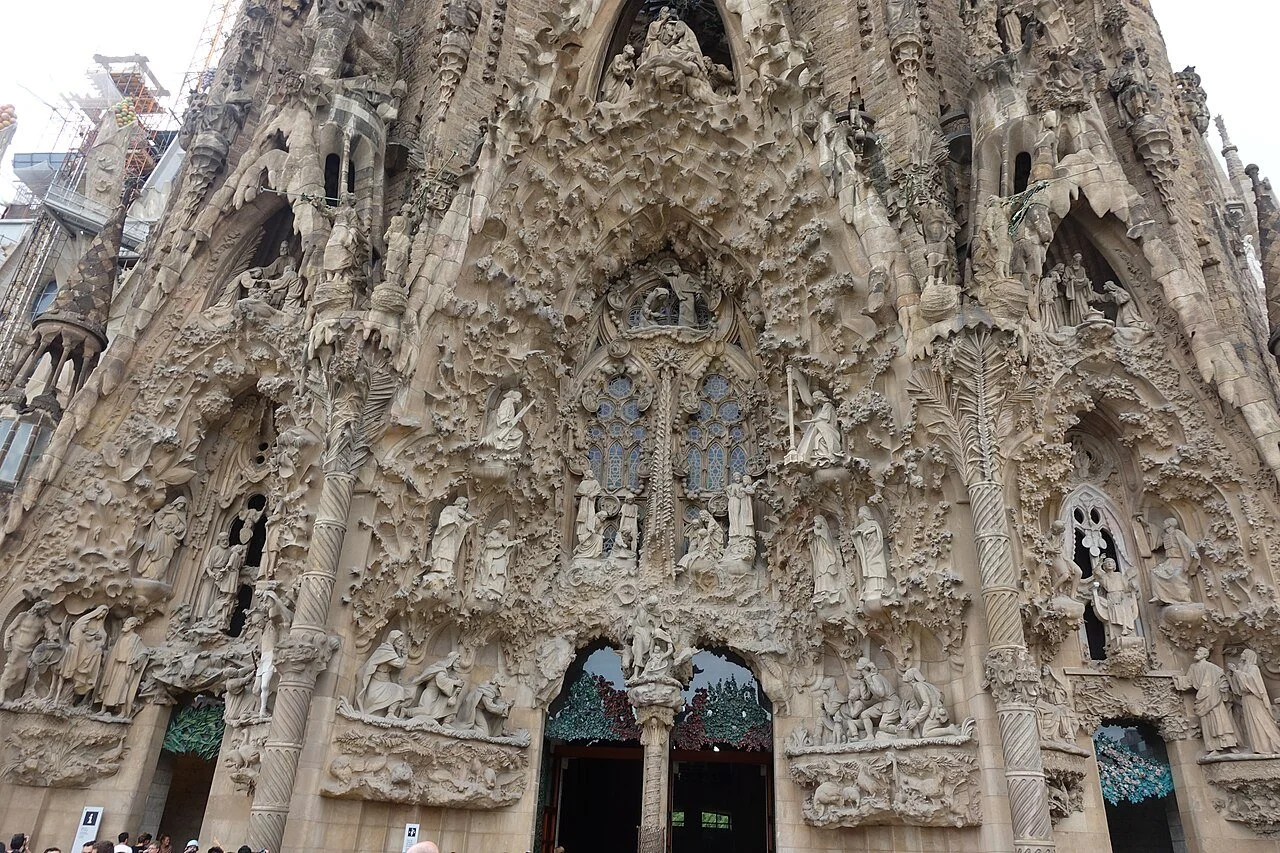
Exterior of the Sagrada Familia by Jose Olgon - Creative Commons License
The Nativity facade celebrates life, fertility, and divine generosity. An explosion of life, overflowing with natural imagery, plants, animals, and human figures, celebrates creation. It communicates a theology of creation where nature itself becomes evidence of divine beauty. The facade overwhelms the observer with its symbolic richness and visual abundance. The Portal of Charity in the center is the most imposing and is dedicated to the canonical story of the birth of Jesus. The Portal of Hope on the left depicts passages such as the Flight into Egypt and the Massacre of the Innocents. The Portal of Faith on the right, dedicated to the life of the Virgin Mary, represents well-known scenes such as the Annunciation, the Wedding at Cana, and the Presentation of Jesus in the Temple. The key feature of the facade’s design is naturalism; the main columns resemble tree trunks, and the stone takes on lifelike forms drawn from nature and carved with rich textures.
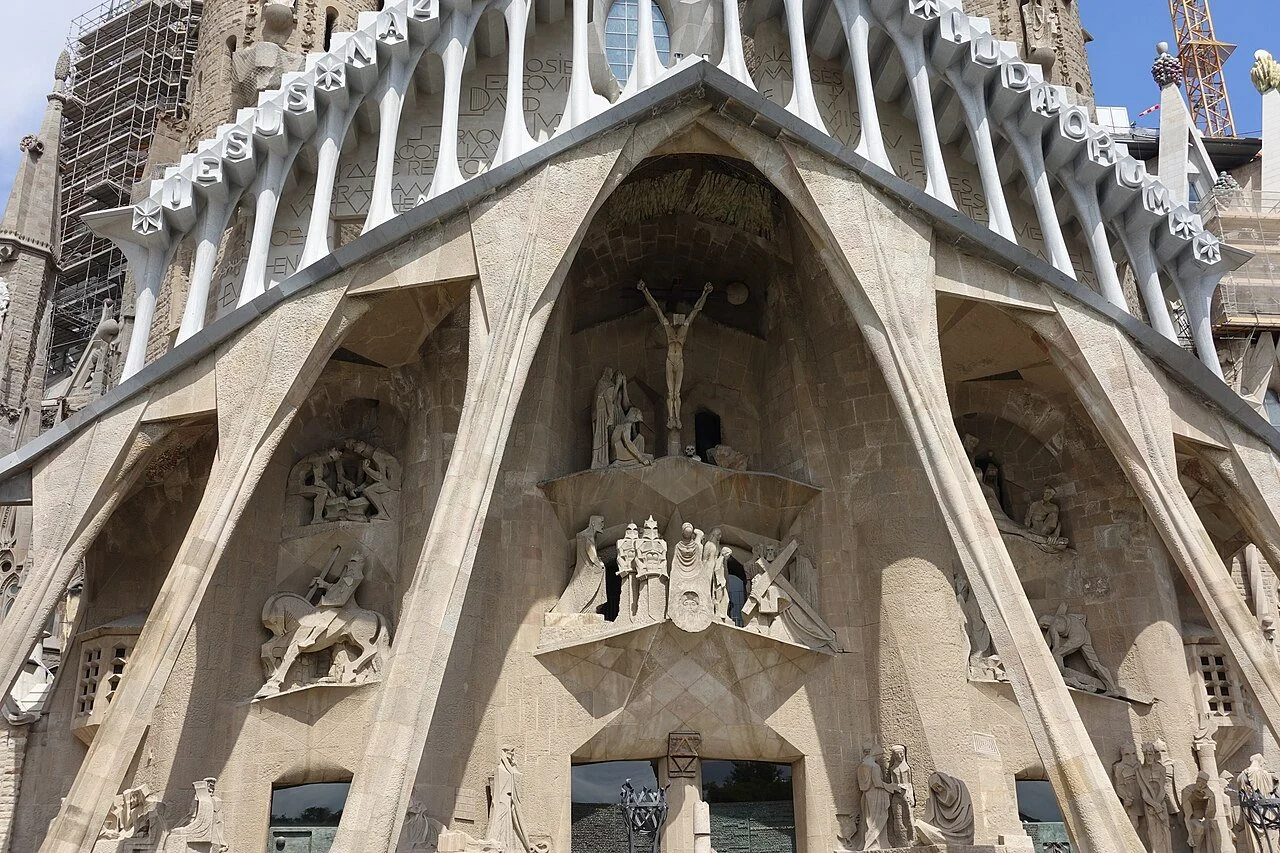
Passion Facade of the Sagrada Familia by Jose Olgon - Creative Commons License
Then you turn a corner and find the Passion facade. It strikes you with a completely different kind of imagery, with an emotional weight that contrasts sharply with the previous facade. It employs a language of angular forms, dramatic shadows, and an austere composition to communicate the suffering, sacrifice, and redemption of Christ, representing Holy Week and telling the story of the Bible and the liturgy in stone. The architecture directly participates in the emotional content of the narrative written on the facade. Gaudí visualized the bones of Jesus's tortured body on the facade; you can even perceive the 33 vertebrae. Located on the west side, it receives the last rays of sunlight, increasing the effect of the dramatic shadows and deep geometric cuts. The impressive front porch is supported by six large, inclined, geometric columns that simulate tendons or taut bones, representing the suffering of Jesus during the Passion.
“The architecture directly participates in the emotional content of the narrative written on the facade. Gaudí visualized the bones of Jesus's tortured body on the facade...”
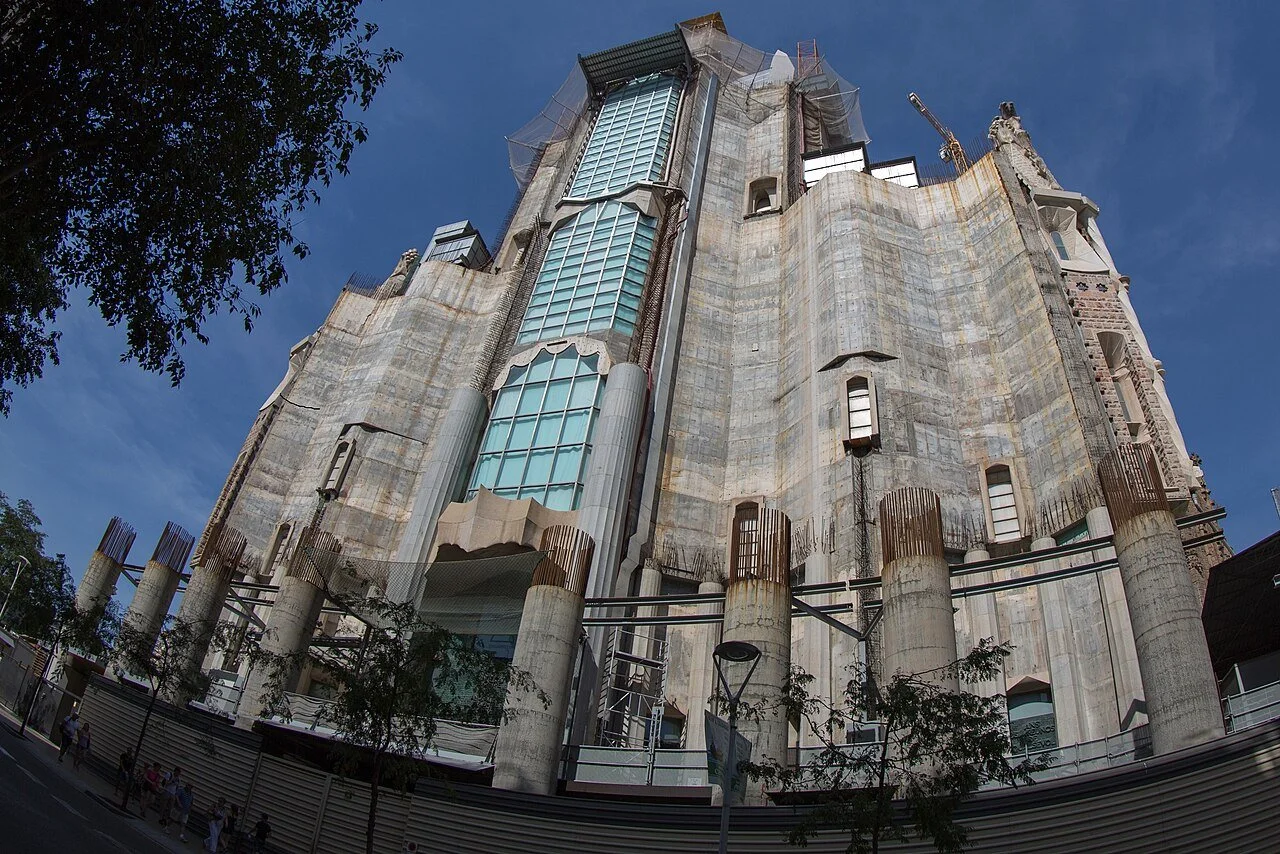
Sagrada Familia by Victor Grigas - Creative Commons License
The main facade, the Glory facade, which is still under construction, addresses the theme of resurrection and eternal life. It is the Basilica's main entrance, the largest and most monumental, and was designed by Gaudí in 1916. Facing Mallorca Street and the sea, it represents the ultimate destiny of humanity: Death, the Last Judgment, Hell, and Eternal Glory. It was conceived as a grand instructional gateway that teaches Catholic doctrine structured on three levels, explaining the soul's path to God. The grand portico of the main entrance rests on eight large columns dedicated to the Beatitudes, the declarations of blessing pronounced by Jesus at the beginning of the Sermon on the Mount.
The most debated aspect of the Glory Facade, and of the Sagrada Familia's construction in general, is not artistic, but rather related to urban planning. This is the main reason why the main facade has not been completed like the others. Gaudí's original design includes a monumental staircase that crosses over Mallorca Street via an elevated bridge to connect the temple with a large pedestrian walkway leading directly to Diagonal Avenue. To achieve this the Construction Board of the Sagrada Familia needs to complete the expropriation and demolition of several well-established residential blocks within the city, directly impacting the housing rights of approximately one thousand families in the Eixample district.

Basilica i Temple Expiatori de la Sagrada Familia by Jiuguang Wang - Creative Commons License
Entering the Sagrada Familia for the first time makes all the other, more ordinary buildings you've visited pale in comparison. Its interior changes something deep inside you. In the vast interior space of the Basilica, the traditional language of classical architecture, with its columns, pilasters, and altarpieces, has been completely replaced by a monumental forest of stone columns. Entering the central nave feels more like walking through a mystical stone forest than inside a cathedral. The columns branch out like ancient trees. As they rise from the ground, their cross-section dynamically changes, beginning with a polyhedral base, going through square shapes, until reaching the round capitals 45 meters (148 feet) above the ground. At the capitals, directly above the columns, they separate into slender, angled stone branches that extend upwards to meet a hyperbolic vaulted roof. Gaudí achieved a complete transfiguration of structural weight by relying entirely on this branching system to transmit the loads of the stone to the ground. Poetically transforming a heavy mountain of stone into a light, floating canopy of stone trees, the boundary between the built environment and nature is completely dissolved. You suddenly feel as if creation itself has become a sacred, liturgical space.
And then you notice the light.
“Entering the central nave feels more like walking through a mystical stone forest than inside a cathedral. The columns branch out like ancient trees”
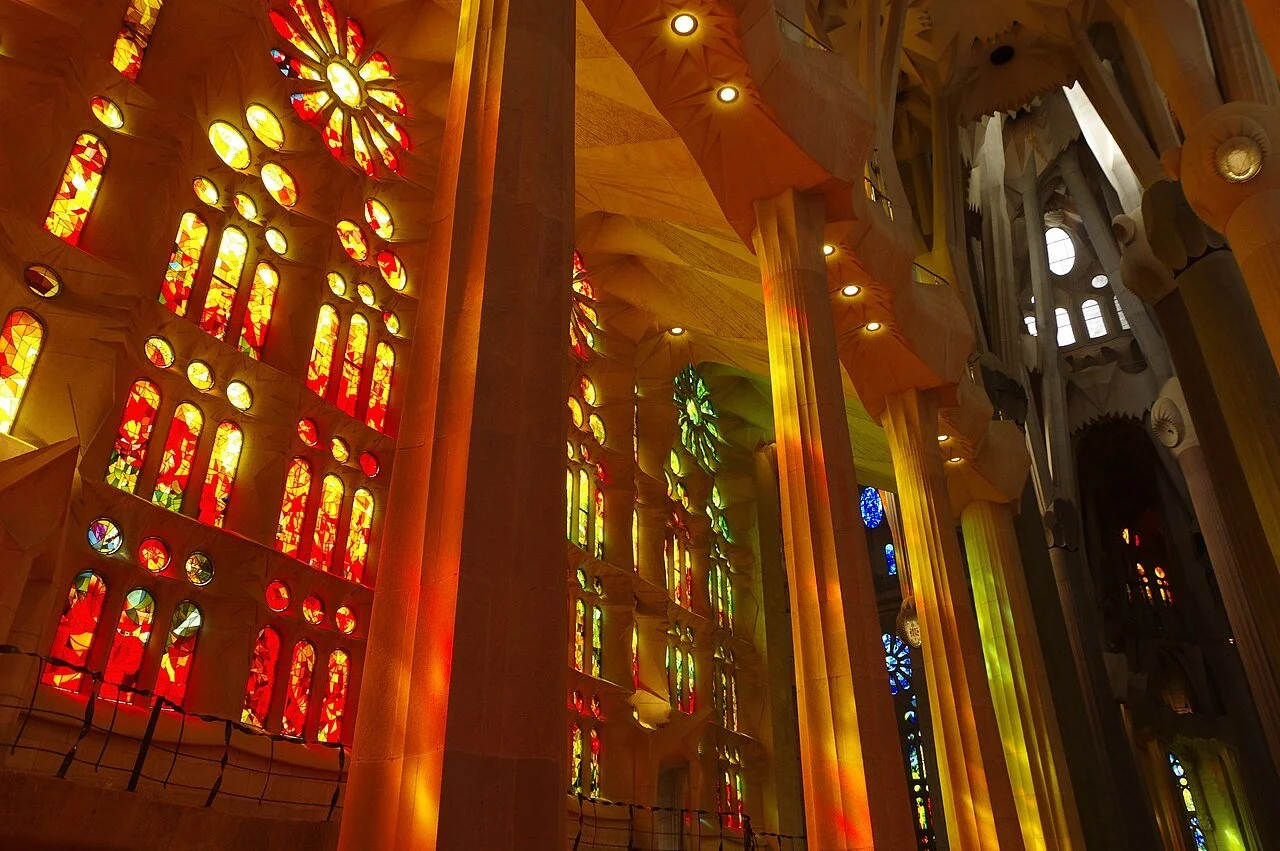
Barcelona Sagrada Familia by Berthold Werner - Creative Commons License
Light doesn’t just illuminate the space, it reveals it. As the sun moves across the sky, the stained-glass windows pour dynamic bursts of deep blues, fiery oranges, and blood reds across the stone. The interior is never visually static; it breathes. Gaudí had an intuitive understanding that light was a powerful trigger for human neurochemistry, helping it to regulate our circadian rhythms, our cortisol levels, and our serotonin production. Gaudí used natural light as an additional malleable material to the stone, rejecting uniform, depthless illumination in interiors and favoring chromatically filtered, highly localized light. He directed natural light to flood the stone surfaces with deep textures, creating complex patterns of light and shadow. The dynamic lighting he employed resembles the dappled light that filters through the canopies of trees in a forest.
Gaudí's approach to the Via Pulchritudinis goes beyond visual aesthetics, incorporating a multi-sensory understanding of human spatial experience. He paid meticulous attention to the haptic qualities of materials where surfaces came in contact with human touch. Doorknobs, railings, and custom-made built-in furniture were crafted from warm, organic materials such as polished wood, bronze, and glazed ceramics, and possess near-perfect ergonomics, conforming appropriately to the parts of the body they touch. Furthermore, the curved, smooth, and non-parallel surfaces Gaudí used, along with porous ceramic mosaics and broken tile surfaces, function as efficient acoustic diffusion systems. Thus, his interiors disperse sound waves and eliminate the strident echoes of crowds, minimizing the background clamor typically found in the cavernous spaces of large temples.
The almost celestial feeling one experiences upon entering the Sagrada Familia, and indeed most of Gaudí's architectural work, demonstrates that beauty can serve as a model to accomplish understanding. By using biomorphic geometry, symbolic richness, and a profound human spatial experience, the Sagrada Familia embodies the Way of Beauty more fully and completely than perhaps any other modern building. Re-employing the Via Pulchritudinis in today's climate, where efficiency, spreadsheets, and an increasingly corporate built environment dominated by commercial optimization, has become a critical necessity. This approach would help us reduce or even eliminate corporate homogeneity and shift the focus from return on investment to something more tangible and human. An architecture guided by the Way of Beauty would affirm the fact that beauty is an essential human need, deeply intertwined with our psychological and emotional well-being. Contemporary architects could use the Via Pulchritudinis to create captivating and fascinating spaces that succeed in opening the human spirit to a meaningful and shared sense of awe and awe.
“The almost celestial feeling one experiences upon entering the Sagrada Familia, and indeed most of Gaudí's architectural work, demonstrates that beauty can serve as a model to accomplish understanding.”
The Way of Beauty should not remain locked within the confines of the history of the Catholic Church, it belongs in the arsenal of our modern tools. In a world currently obsessed with economic efficiency, glass boxes, and hyper-optimized sterile spaces, we desperately need architecture grounded on human flourishing. I often think about the application of the principles of Gaudism when I imagine an architecture placed in vulnerable tropical landscapes, principles such as biomorphic coherence, symbolic legibility, material honesty, and constant wonder. In places where natural light abounds, and life in outdoor spaces is a natural part of the daily rhythm of life. The Way of Beauty is not a luxury for the elite or a relic of the past, but rather a strategic guide to using sustainability, beauty, and structure as a map to the future.
